
24/7 Emergency Hospital in Chittagong
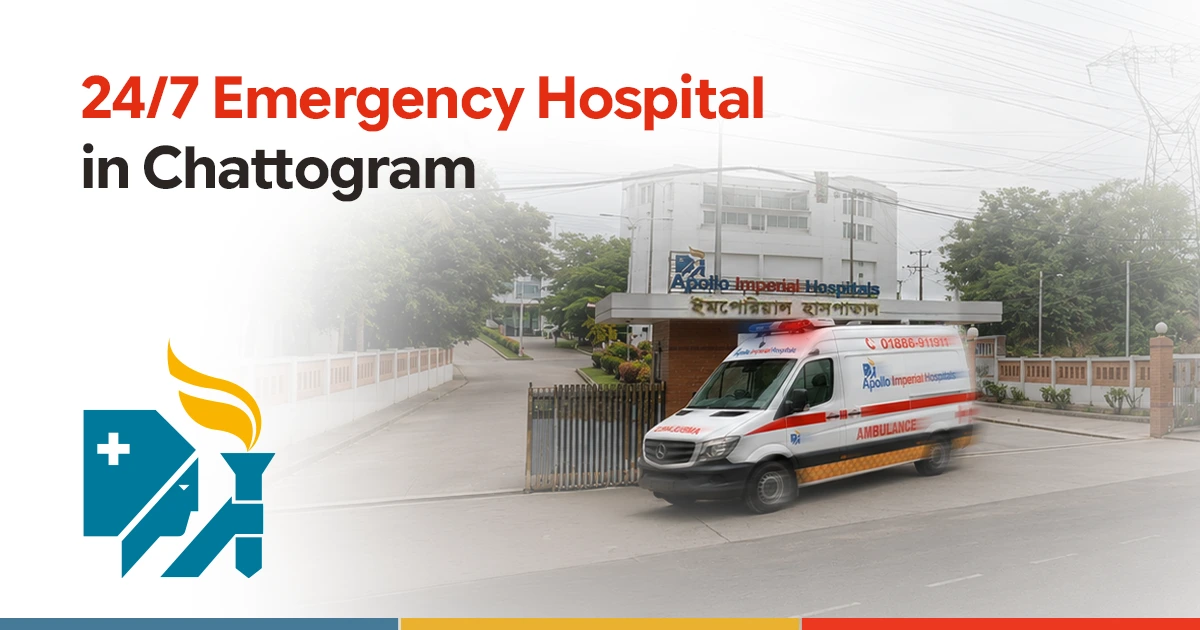
In a cardiac arrest, the brain begins to suffer damage within four to six minutes. In severe trauma, most preventable deaths happen in the first hour after injury. The hospital you reach in that window decides the outcome, which is why knowing your nearest emergency department matters before you ever need it.
Apollo Imperial Hospitals (AIH) sits near Foy’s Lake in Chattogram, reachable from any part of the city, with parking on site and a 24-hour Accident and Emergency Department that treats every age group.
Why a Nearby Hospital Matters in an Emergency
Distance costs minutes, and minutes cost outcomes. A stroke patient who reaches a hospital early can receive thrombolysis, since that treatment window closes at four and a half hours from symptom onset. A heart attack patient who arrives early can go straight to coronary angiography. A road traffic accident victim who arrives early gets airway control and blood before shock becomes irreversible.
So, instead of searching for “hospitals near me” during an emergency, keep note of the most reliable hospitals near you with 24/7 emergency service so that you can get prompt treatment right in time.
Our emergency department, ICU, laboratory, radiology, and operation theaters sit inside one building, so a critically ill patient moves between them in minutes. No transfer across the city, no second admission process.
Inside the Accident and Emergency Department
Our A&E department was built as a large, dedicated unit with equipment matched to the severity of each case. Patients are sorted by triage level on arrival, so the sickest person is seen first regardless of arrival order. This dedicated triage area is the first of its kind in Bangladesh.
The department holds:
- A wide waiting area with a front desk and customer care officers on duty;
- Ten separate treatment and observation cubicles, each giving privacy along with full monitoring;
- Two resuscitation rooms with four resuscitation beds, modern ventilators, biphasic defibrillators, and advanced life support equipment;
- A negatively pressured isolation room with dedicated equipment for suspected infectious cases, another first in Bangladesh;
- A trauma, procedure, and cast room for road traffic accidents and other injuries;
- A neonatal resuscitation room equipped for newborns;
- A modern operation theatre ready for emergency and day care surgery under general, spinal, or local anaesthesia;
- A decontamination and mass casualty area, the first in the country, for removing chemical, radioactive, and infectious contamination before a patient enters the main hospital.
Emergency physicians staff the department around the clock, backed by trained emergency nurses and support staff.
Emergency Ambulance Service Across Bangladesh
Treatment starts before the patient reaches us. AIH runs a fleet of six ambulances, positioned to cover major areas and dispatched through our communication system so the nearest vehicle responds.
Four of these are Basic Life Support (BLS) ambulances, carrying patient monitoring devices, oxygen delivery systems, immobilization equipment, and essential emergency supplies. They suit stable patients who need monitored transport.
Two are Advanced Life Support (ALS) ambulances, carrying cardiac monitors, defibrillators, infusion pumps, ventilators, and advanced airway equipment. Trained paramedics on these units perform cardiac monitoring, intravenous therapy, defibrillation, and airway management while the vehicle is moving.
Our crews stabilize trauma victims at the accident scene and manage cardiac emergencies during transfer so the patient arrives at the hospital already receiving treatment.
Critical Care Medicine at Apollo Imperial Hospitals
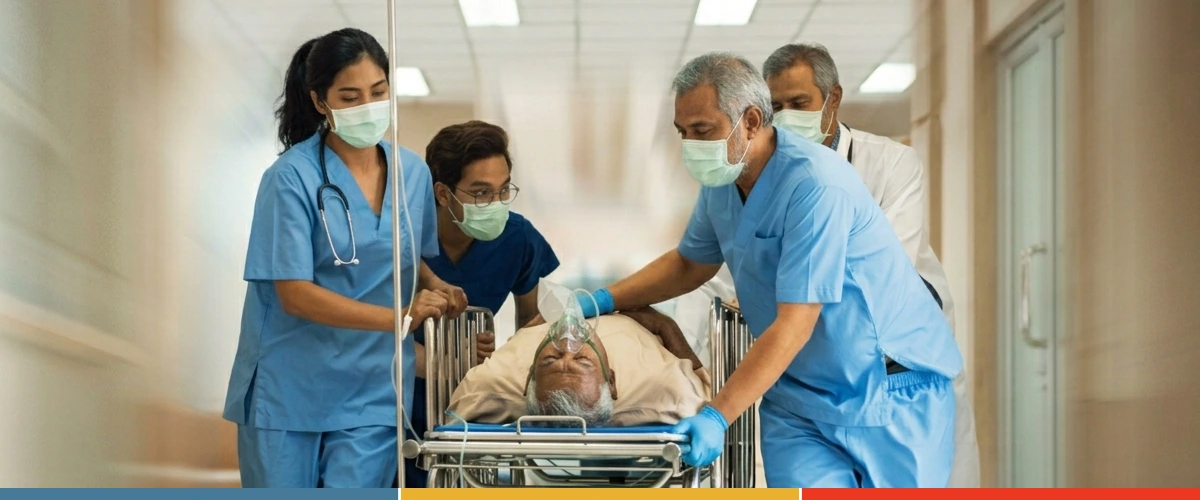
Our Critical Care Medicine department runs 66 beds across the General ICU, Surgical ICU, Cardiac ICU, CCU, and HDU, making it the largest critical care setup in the region.
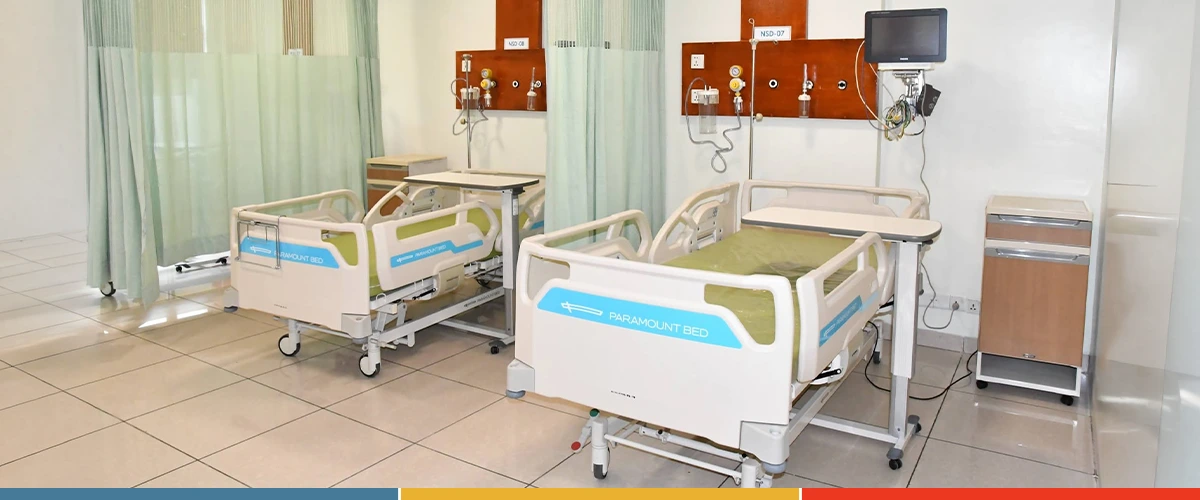
An ICU specialist supervises management 24 hours a day, and every patient occupies a single cubicle. Nursing runs at a one-to-one ratio, meaning one nurse for one patient throughout the shift.
Each bed carries the latest monitors, third-generation mechanical ventilators, and non-invasive ventilation (NIV) support. For highly infectious or immunocompromised patients, we have isolation beds with positive and negative pressure air systems.
Our ICU physicians perform bedside critical care ultrasonography around the clock, including lung ultrasound and critical care echocardiography, which lets the team assess fluid status and cardiac function without moving an unstable patient.
Advanced ICU Therapies
Several treatments at AIH were introduced to Chittagong for the first time.
This includes:
Bedside SLED and CRRT. Sustained low-efficiency dialysis and continuous renal replacement therapy were first offered in Chittagong at AIH. Both suit patients whose blood pressure cannot tolerate conventional intermittent hemodialysis, which covers most patients in shock with acute kidney injury.
Cytosorb therapy. This blood purification treatment removes inflammatory mediators from circulation and is used in septic shock, rhabdomyolysis, and acute liver failure.
Bedside therapeutic plasma exchange. This treatment is available for patients when the indication justifies it and can be performed without transferring the patient out of the unit.
MRI-compatible ventilators and syringe pumps. AIH is the only hospital in the area with this equipment, so we can perform MRIs on a ventilated patient who is running on multiple vasopressors and inotropes. Elsewhere, that scan simply waits until the patient stabilizes, and sometimes that delay changes the diagnosis.
Bedside endoscopy and bronchoscopy. Both are performed inside the ICU, useful for gastrointestinal bleeding and for clearing the airway in ventilated patients.
Dedicated surgical ICU. General surgery and neurosurgery patients recover in a separate surgical ICU with staff trained for post-operative complications.
Faster Diagnosis in the Critical Phase
Our laboratory and radiology departments support the ICU and emergency department 24 hours a day, seven days a week.
For critically ill patients, we run respiratory panel PCR and sepsis panel PCR, which identify the causative organism far sooner than conventional culture. Blood culture usually needs 48 to 72 hours before it names a pathogen. PCR panels shorten that gap, so antibiotic therapy narrows from broad-spectrum to targeted within the first day of admission.
Radiology offers CT, MRI, ultrasonography, and digital X-ray on the ground floor of the Diagnostic and Therapeutic block, next to emergency.
Our blood bank supplies red cell concentrate, apheresis platelets, and fresh frozen plasma, which matters in major trauma and obstetric hemorrhage where transfusion has to start immediately.
Infection control across the ICU and operation theatres is handled by our infection control department and Central Sterile Supply Department (CSSD), because ventilator-associated pneumonia and central line infections kill patients who survive their original illness.
Cardiac Emergencies
Chest pain arriving at our emergency department moves quickly into cardiac assessment through ECG, echocardiography, and coronary angiography. Our cardiac surgeons perform open heart surgery, minimally invasive cardiac surgery (MICS), and minimally invasive direct coronary artery bypass (MIDCAB). Postoperative patients recover in the Cardiac ICU and CCU.
FAQs
Does Apollo Imperial Hospitals have a 24-hour emergency department?
Yes. Our Accident and Emergency Department operates every hour of every day with emergency physicians, trained nurses, and resuscitation facilities on site.
Can the hospital handle road traffic accidents and major trauma?
Yes. We have a dedicated trauma, procedure, and cast room; two resuscitation rooms with four beds; an emergency operation theater; blood bank support; and a decontamination and mass casualty area.
Do you provide ambulance service?
Yes. Six ambulances operate 24 hours a day, four with Basic Life Support and two with Advanced Life Support equipment and trained paramedics.
How many ICU beds do you have?
Sixty-six, spread across the General ICU, Surgical ICU, Cardiac ICU, CCU, and HDU, with one-to-one nursing and 24-hour supervision by an ICU specialist.
Can newborns be treated in an emergency?
Yes. Our emergency department has a dedicated neonatal resuscitation room, and the hospital runs NICU, PICU, and SCABU services along with kangaroo mother care.
What if a patient needs affordable intensive care?
Our lower-cost ICU service, Nibir, gives access to monitored critical care at a reduced price. Save our care center number on your phone today. In an emergency, the person who already knows where to go loses no time deciding.
Dr. Safayat Bin Amin
MBBS (CMU)
Diploma in Public Health and Diploma in Immunology