
MRI Test in Chittagong: 3 Tesla Technology, Price & What to Expect
If your doctor has recommended an MRI, you may want to know where to have the scan and how much it will cost. Here’s what to know about MRI testing in Chattogram, including the 3 Tesla MRI available at Apollo Imperial Hospitals.
What is an MRI Test?
An MRI (Magnetic Resonance Imaging) scan uses a strong magnet and radio waves, without radiation, to build detailed images of the inside of your body. It’s especially good at showing soft tissue: your brain, spinal cord, joints, and organs, in a level of detail an X-ray or ultrasound can’t match. A scan usually takes 20 to 60 minutes, depending on which part of the body is being imaged.
MRI Machine at Apollo Imperial Hospitals
AIH runs a Siemens MAGNETOM Skyra, a 3 Tesla (3T) MRI with Tim 4G technology and Deep Resolve reconstruction.
Why 3 Tesla makes a difference:
A 3T magnet is roughly twice as strong as the 1.5T machines still common at many centers. That extra strength gives a much better signal-to-noise ratio. The stronger magnetic field can provide a higher signal-to-noise ratio, which can help produce detailed images. The machine can pick up finer detail without needing as long a scan. That’s what makes 3T especially valuable for brain imaging (catching small lesions or early-stage tumors), spine and joint scans (seeing ligament and cartilage tears clearly), and vascular imaging (often without needing contrast dye at all).
In practical terms, that means:
- 3T MRI can provide detailed images and may be particularly useful for certain brain, spine, joint, and vascular examinations.
- Faster scans: Deep Resolve technology reconstructs high-resolution images in less scan time, so you spend less time in the machine
- Fewer repeat scans: built-in motion sensing reduces the movement artifacts that would otherwise force a re-scan
This isn’t the only imaging equipment on-site, either. AIH’s radiology department also runs CT, digital mammography, ultrasound, fluoroscopy, bone density (BMD), and interventional radiology, so if your scan turns up something that needs a follow-up test, it’s usually available under the same roof. See the full Radiology and Imaging department for details.
Why Patients Travel to Apollo Imperial Hospitals for This Scan
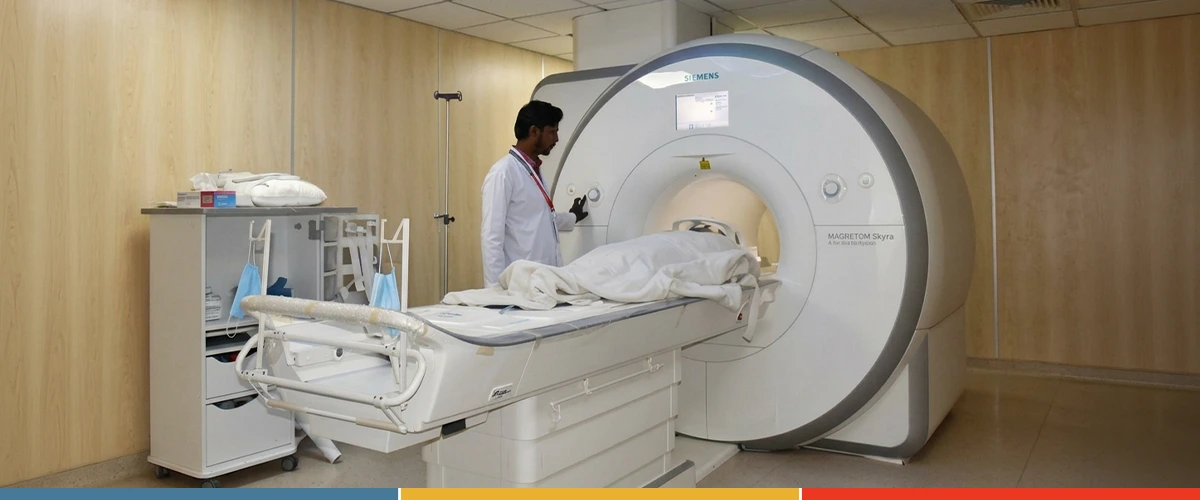
The MRI scanner is only one part of the service. The radiologist’s interpretation of the images is also an important part of the examination. The 3T Siemens Skyra is still not something every diagnostic center in Chattogram runs, and it’s a big part of why patients come to AIH for this test from across the district and beyond, especially for scans where fine detail can actually change the diagnosis.
The technology is only half of it, though. Every scan is reviewed by experienced radiologists who take the time to check the images carefully before the report goes out. The images are reviewed by radiologists, who prepare the diagnostic report for the referring doctor.
What to Look for When Choosing Where to Get an MRI in Chattogram
A few practical things are worth checking before booking an MRI. Ask what type of MRI scanner the center uses, particularly if your doctor has requested a specific type of scan. You can also ask how long the examination is expected to take and when the report will be available.
A few things actually matter more than others when you’re picking a center:
- Magnet strength. 3 Tesla machines produce sharper images and often scan faster than the more common 1.5 Tesla machines worth asking which one a center uses, especially for brain, spine, or joint MRIs.
- How long will you be in the machine? Longer scan times mean a greater chance of movement, which can blur the images and mean coming back for a repeat scan.
- Report turnaround. Ask how soon you’ll get your report, and whether it’s shared digitally.
- Whether it’s a one-stop visit. If your doctor might need a CT, ultrasound, or blood work alongside the MRI, having it all in one hospital saves you a second trip.
If you need other tests, such as a CT scan, ultrasound, or blood work, it may also be convenient to choose a hospital where these services are available at the same location.
How the MRI Scan Works
The MRI machine makes loud tapping and knocking sounds during the scan. You may be given earplugs or headphones to reduce the noise. It’s important to stay as still as possible while the images are being taken.
- You lie down on a table that slides into the scanner.
- The machine builds a magnetic field around your body and sends radio wave pulses through it.
- Your body’s tissue responds to those pulses, and the machine picks up the signal.
- A computer turns that signal into detailed cross-sectional images your doctor can read.
Preparing for Your MRI
- Remove jewelry, watches, and anything metal before the scan
- Tell the staff if you have ever had metal fragments in your eyes or body, or if you have had previous surgery involving metal implants.
- Some scans require fasting beforehand; confirm this when you book
- Wear comfortable clothing without metal fasteners if possible
- Let staff know if you’re pregnant or think you might be
Onuvab: Fixed-Rate Diagnostic Services
If you’re comparing the cost of diagnostic tests in Chattogram, Apollo Imperial Hospitals also offers Onuvab, a healthcare package with fixed and transparent rates. The program includes several diagnostic services, including MRI, CT scans, and X-rays, along with health check-ups and specialist consultations.
For patients who need diagnostic tests, having fixed-rate options can make it easier to understand the expected cost before booking. You can check the current Onuvab rates and available services on the Apollo Imperial Hospitals Onuvab page.
FAQs
Is a 3 Tesla MRI available in Chattogram?
Yes. Apollo Imperial Hospitals runs a Siemens MAGNETOM Skyra 3 Tesla MRI, a step up in image clarity and scan speed from the 1.5 Tesla machines still common at many centers.
How long does an MRI scan take?
Most MRI examinations take around 20 to 60 minutes, although the exact time depends on the type of scan and the area being examined.
Is an MRI scan painful?
MRI itself is not painful. You need to remain still while the images are taken, and the machine makes loud sounds during the scan. Some people may find staying inside the scanner uncomfortable.
Can I have an MRI if I have a pacemaker?
It depends on the type of pacemaker and whether it is MRI-compatible. Tell the MRI team about any pacemaker, implant, or other metal device before the scan so they can determine whether the examination is safe.
Need an MRI or want to check pricing for your specific scan? Call 09610-847-847 Apollo Imperial Hospitals, Chattogram.
Dr. Safayat Bin Amin
MBBS (CMU)
Diploma in Public Health and Diploma in Immunology